Calculation of normal and shear stress on a plane
It is often necessary to calculate the normal and the shear stress on an arbitrary plane (with unit normal vector ) through a point of a body in equilibrium. Faults or cracks that cross the rock mass and may lead to rock failure are cases that require the estimation of the stress components on a plane. Another example is the calculation of the normal and shear stress on the failure surface of a specimen during a typical rock mechanics experiment.
The components of the stress vector acting on any plane through an arbitrary point inside a body may be calculated from Cauchy’s formula:
where is the stress tensor describing the stress state at that point and are the components of the unit normal vector of the plane. In the above Eq. (1), the summation convention has been used. Cauchy’s formula is often written as ; the two forms are equivalent because the stress tensor is symmetric, (see Equilibrium equations).
The stress vector can be broken down into two components, the normal stress and the shear stress, as shown in Fig. 1.
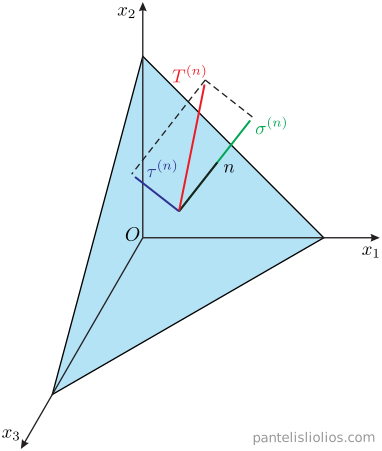
The normal stress is the projection of the stress vector on the normal of the plane:
Note that is a signed quantity. In continuum mechanics tensile stresses are taken as positive and compressive stresses as negative; in rock mechanics the opposite convention, with compression positive, is also frequently used.
Since the normal and the shear components are perpendicular to each other, the magnitude of the shear stress follows from the Pythagorean theorem:
The shear stress vector itself, which also gives the direction of shearing on the plane, is obtained by subtracting the normal component from the stress vector:
Example
The stress state at a point is given by the following stress tensor:
For a plane with unit normal:
calculate the normal and shear components of the stress vector.
Solution
First, we calculate the normal stress using Eq. (2). Taking into account the symmetry of the stress tensor:
To calculate the shear component, we first need the components of the stress vector from Eq. (1):
As a check, the normal stress can also be calculated directly from these components, . The magnitude of the stress vector squared is:
Finally, from Eq. (3), the magnitude of the shear stress is:
Note that rounding the intermediate results too early, e.g. to one decimal place, leads to a noticeably different shear stress, because is calculated as the difference of two large numbers.
The shear stress vector is obtained from Eq. (4):
Its magnitude, , agrees with the previous result, and it is indeed perpendicular to the normal of the plane, .