The transformation (rotation) of a tensor into a new coordinate system is a common problem in rock mechanics and in continuum mechanics in general. In this article we present the necessary equations and an example, using the stress tensor as an example.
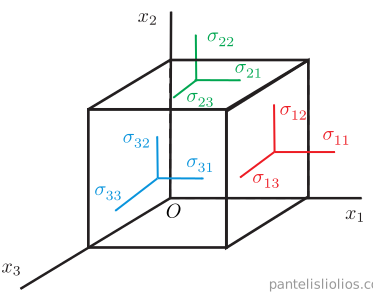
Consider a body in equilibrium and a coordinate system. The stress state at any internal point of this body is given by the stress tensor (cf. Fig. 1 ):
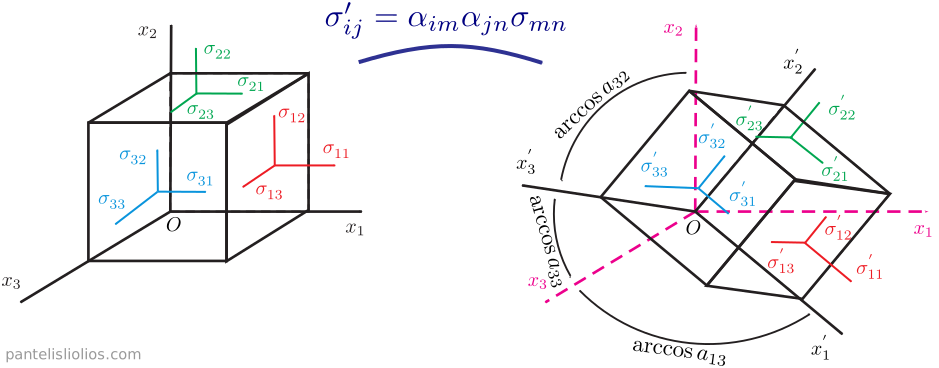
σ i j = [ σ 11 σ 12 σ 13 σ 21 σ 22 σ 23 σ 31 σ 32 σ 33 ] (1) \sigma_{ij}=\left[\begin{array}{ccc}\sigma_{11} & \sigma_{12} & \sigma_{13}\\ \sigma_{21} & \sigma_{22} & \sigma_{23}\\ \sigma_{31} & \sigma_{32} & \sigma_{33}\end{array}\right] \tag{1} σ ij = σ 11 σ 21 σ 31 σ 12 σ 22 σ 32 σ 13 σ 23 σ 33 ( 1 ) Figure 1: Elementary volume representing a point in a body under static equilibrium and geometrical representation of the components of the Cauchy stress tensor. Now consider a second coordinate system that is rotated with respect to the original one. The stress tensor may be transformed into the new coordinate system according to the tensor transformation rule (cf. Fig. 2 ):
σ i j ′ = α i m α j n σ m n (2) \sigma'_{ij}=\alpha_{im}\alpha_{jn}\sigma_{mn} \tag{2} σ ij ′ = α im α j n σ mn ( 2 ) where the summation convention has been used. The quantity:
α i j = [ α 11 α 12 α 13 α 21 α 22 α 23 α 31 α 32 α 33 ] (3) \alpha_{ij}=\left[\begin{array}{ccc}\alpha_{11} & \alpha_{12} & \alpha_{13} \\ \alpha_{21} & \alpha_{22} & \alpha_{23} \\ \alpha_{31} & \alpha_{32} & \alpha_{33}\end{array}\right] \tag{3} α ij = α 11 α 21 α 31 α 12 α 22 α 32 α 13 α 23 α 33 ( 3 ) is the rotation (transformation) matrix, whose elements are the direction cosines between the axes of the two coordinate systems:
α i j = cos ( x i ′ , x j ) = e ⃗ i ′ ⋅ e ⃗ j (4) \alpha_{ij}=\cos(x'_{i},x_{j})=\vec{e}\,'_{i}\cdot\vec{e}_{j} \tag{4} α ij = cos ( x i ′ , x j ) = e i ′ ⋅ e j ( 4 ) The first index refers to the new (primed) axis and the second index to the old (unprimed) axis (Fig. 2 ). The rotation matrix is orthogonal, i.e. its inverse is equal to its transpose:
α i k α j k = δ i j (5) \alpha_{ik}\alpha_{jk}=\delta_{ij} \tag{5} α ik α j k = δ ij ( 5 ) Thanks to this property, the inverse transformation, from the new to the old coordinate system, is simply:
σ i j = α m i α n j σ m n ′ (6) \sigma_{ij}=\alpha_{mi}\alpha_{nj}\sigma'_{mn} \tag{6} σ ij = α mi α nj σ mn ′ ( 6 ) In matrix form, Eq. (2) is written as:
σ ′ = α σ α T (7) \sigma'=\alpha\,\sigma\,\alpha^{T} \tag{7} σ ′ = α σ α T ( 7 ) which is the most convenient form for calculations. The same rule applies to any second-order tensor, e.g. the strain tensor, while a vector is transformed as v i ′ = α i j v j v'_{i}=\alpha_{ij}v_{j} v i ′ = α ij v j
Figure 2: Rotation of the stress tensor to a new coordinate system according to the transformation rule. Example
Assume the following stress tensor:
σ i j = [ 5 3 1 3 2 0 1 0 4 ] (8) \sigma_{ij}=\left[\begin{array}{ccc}5 & 3 & 1\\ 3 & 2 & 0\\ 1 & 0 & 4\end{array}\right] \tag{8} σ ij = 5 3 1 3 2 0 1 0 4 ( 8 ) Rotate the coordinate system by 60 60 60 1 1 1 x 1 x_{1} x 1
Solution
Axis 1 1 1 1 1 1 0 0 0 1 1 1 2 2 2 3 3 3 π 2 \dfrac{\pi}{2} 2 π 2 2 2 1 1 1 π 2 \dfrac{\pi}{2} 2 π 2 2 2 2 2 2 π 3 \dfrac{\pi}{3} 3 π 2 2 2 3 3 3 π 6 \dfrac{\pi}{6} 6 π 3 3 3 1 1 1 π 2 \dfrac{\pi}{2} 2 π 3 3 3 2 2 2 3 3 3 5 π 6 \dfrac{5\pi}{6} 6 5 π π 3 \dfrac{\pi}{3} 3 π
α i j = [ cos 0 cos π 2 cos π 2 cos π 2 cos π 3 cos π 6 cos π 2 cos 5 π 6 cos π 3 ] = [ 1 0 0 0 1 2 3 2 0 − 3 2 1 2 ] (9) \begin{array}{rl}\alpha_{ij}=&\left[\begin{array}{ccc}\cos0 & \cos\dfrac{\pi}{2} & \cos\dfrac{\pi}{2} \\ \cos\dfrac{\pi}{2} & \cos\dfrac{\pi}{3} & \cos\dfrac{\pi}{6} \\ \cos\dfrac{\pi}{2} & \cos\dfrac{5\pi}{6} & \cos\dfrac{\pi}{3}\end{array}\right]=\left[\begin{array}{ccc}1 & 0 & 0 \\ 0 & \dfrac{1}{2} & \dfrac{\sqrt{3}}{2} \\ 0 & -\dfrac{\sqrt{3}}{2} & \dfrac{1}{2}\end{array}\right]\end{array} \tag{9} α ij = cos 0 cos 2 π cos 2 π cos 2 π cos 3 π cos 6 5 π cos 2 π cos 6 π cos 3 π = 1 0 0 0 2 1 − 2 3 0 2 3 2 1 ( 9 ) α i j = [ cos 0 cos π 2 cos π 2 cos π 2 cos π 3 cos π 6 cos π 2 cos 5 π 6 cos π 3 ] = [ 1 0 0 0 1 2 3 2 0 − 3 2 1 2 ] (9) \begin{array}{rl}\alpha_{ij}=&\left[\begin{array}{ccc}\cos0 & \cos\dfrac{\pi}{2} & \cos\dfrac{\pi}{2} \\ \cos\dfrac{\pi}{2} & \cos\dfrac{\pi}{3} & \cos\dfrac{\pi}{6} \\ \cos\dfrac{\pi}{2} & \cos\dfrac{5\pi}{6} & \cos\dfrac{\pi}{3}\end{array}\right]\\&=\left[\begin{array}{ccc}1 & 0 & 0 \\ 0 & \dfrac{1}{2} & \dfrac{\sqrt{3}}{2} \\ 0 & -\dfrac{\sqrt{3}}{2} & \dfrac{1}{2}\end{array}\right]\end{array} \tag{9} α ij = cos 0 cos 2 π cos 2 π cos 2 π cos 3 π cos 6 5 π cos 2 π cos 6 π cos 3 π = 1 0 0 0 2 1 − 2 3 0 2 3 2 1 ( 9 ) It is easy to verify that this matrix satisfies the orthogonality condition, Eq. (5) . The new stress tensor is most easily calculated from the matrix form, Eq. (7) . Alternatively, Eq. (2) can be written out for each component; taking into account that the stress tensor is symmetric, σ i j = σ j i \sigma_{ij}=\sigma_{ji} σ ij = σ j i Equilibrium equations ), this gives:
σ 11 ′ = α 11 2 σ 11 + α 12 2 σ 22 + α 13 2 σ 33 + 2 α 11 α 12 σ 12 + 2 α 11 α 13 σ 13 + 2 α 12 α 13 σ 23 σ 22 ′ = α 21 2 σ 11 + α 22 2 σ 22 + α 23 2 σ 33 + 2 α 21 α 22 σ 12 + 2 α 21 α 23 σ 13 + 2 α 22 α 23 σ 23 σ 33 ′ = α 31 2 σ 11 + α 32 2 σ 22 + α 33 2 σ 33 + 2 α 31 α 32 σ 12 + 2 α 31 α 33 σ 13 + 2 α 32 α 33 σ 23 σ 12 ′ = α 11 α 21 σ 11 + α 12 α 22 σ 22 + α 13 α 23 σ 33 + ( α 11 α 22 + α 12 α 21 ) σ 12 + ( α 12 α 23 + α 13 α 22 ) σ 23 + ( α 11 α 23 + α 13 α 21 ) σ 13 σ 23 ′ = α 21 α 31 σ 11 + α 22 α 32 σ 22 + α 23 α 33 σ 33 + ( α 21 α 32 + α 22 α 31 ) σ 12 + ( α 22 α 33 + α 23 α 32 ) σ 23 + ( α 21 α 33 + α 23 α 31 ) σ 13 σ 13 ′ = α 11 α 31 σ 11 + α 12 α 32 σ 22 + α 13 α 33 σ 33 + ( α 11 α 32 + α 12 α 31 ) σ 12 + ( α 12 α 33 + α 13 α 32 ) σ 23 + ( α 11 α 33 + α 13 α 31 ) σ 13 (10) \begin{array}{rl} \sigma'_{11}=&\alpha_{11}^{2}\sigma_{11}+\alpha_{12}^{2}\sigma_{22}+\alpha_{13}^{2}\sigma_{33}\\ &+2\alpha_{11}\alpha_{12}\sigma_{12}+2\alpha_{11}\alpha_{13}\sigma_{13}+2\alpha_{12}\alpha_{13}\sigma_{23}\\ \sigma'_{22}=&\alpha_{21}^{2}\sigma_{11}+\alpha_{22}^{2}\sigma_{22}+\alpha_{23}^{2}\sigma_{33}\\ &+2\alpha_{21}\alpha_{22}\sigma_{12}+2\alpha_{21}\alpha_{23}\sigma_{13}+2\alpha_{22}\alpha_{23}\sigma_{23}\\ \sigma'_{33}=&\alpha_{31}^{2}\sigma_{11}+\alpha_{32}^{2}\sigma_{22}+\alpha_{33}^{2}\sigma_{33}\\ &+2\alpha_{31}\alpha_{32}\sigma_{12}+2\alpha_{31}\alpha_{33}\sigma_{13}+2\alpha_{32}\alpha_{33}\sigma_{23}\\ \sigma'_{12}=&\alpha_{11}\alpha_{21}\sigma_{11}+\alpha_{12}\alpha_{22}\sigma_{22}+\alpha_{13}\alpha_{23}\sigma_{33}\\ &+(\alpha_{11}\alpha_{22}+\alpha_{12}\alpha_{21})\sigma_{12}+(\alpha_{12}\alpha_{23}+\alpha_{13}\alpha_{22})\sigma_{23}\\ &+(\alpha_{11}\alpha_{23}+\alpha_{13}\alpha_{21})\sigma_{13}\\ \sigma'_{23}=&\alpha_{21}\alpha_{31}\sigma_{11}+\alpha_{22}\alpha_{32}\sigma_{22}+\alpha_{23}\alpha_{33}\sigma_{33}\\ &+(\alpha_{21}\alpha_{32}+\alpha_{22}\alpha_{31})\sigma_{12}+(\alpha_{22}\alpha_{33}+\alpha_{23}\alpha_{32})\sigma_{23}\\ &+(\alpha_{21}\alpha_{33}+\alpha_{23}\alpha_{31})\sigma_{13}\\ \sigma'_{13}=&\alpha_{11}\alpha_{31}\sigma_{11}+\alpha_{12}\alpha_{32}\sigma_{22}+\alpha_{13}\alpha_{33}\sigma_{33}\\ &+(\alpha_{11}\alpha_{32}+\alpha_{12}\alpha_{31})\sigma_{12}+(\alpha_{12}\alpha_{33}+\alpha_{13}\alpha_{32})\sigma_{23}\\ &+(\alpha_{11}\alpha_{33}+\alpha_{13}\alpha_{31})\sigma_{13}\end{array} \tag{10} σ 11 ′ = σ 22 ′ = σ 33 ′ = σ 12 ′ = σ 23 ′ = σ 13 ′ = α 11 2 σ 11 + α 12 2 σ 22 + α 13 2 σ 33 + 2 α 11 α 12 σ 12 + 2 α 11 α 13 σ 13 + 2 α 12 α 13 σ 23 α 21 2 σ 11 + α 22 2 σ 22 + α 23 2 σ 33 + 2 α 21 α 22 σ 12 + 2 α 21 α 23 σ 13 + 2 α 22 α 23 σ 23 α 31 2 σ 11 + α 32 2 σ 22 + α 33 2 σ 33 + 2 α 31 α 32 σ 12 + 2 α 31 α 33 σ 13 + 2 α 32 α 33 σ 23 α 11 α 21 σ 11 + α 12 α 22 σ 22 + α 13 α 23 σ 33 + ( α 11 α 22 + α 12 α 21 ) σ 12 + ( α 12 α 23 + α 13 α 22 ) σ 23 + ( α 11 α 23 + α 13 α 21 ) σ 13 α 21 α 31 σ 11 + α 22 α 32 σ 22 + α 23 α 33 σ 33 + ( α 21 α 32 + α 22 α 31 ) σ 12 + ( α 22 α 33 + α 23 α 32 ) σ 23 + ( α 21 α 33 + α 23 α 31 ) σ 13 α 11 α 31 σ 11 + α 12 α 32 σ 22 + α 13 α 33 σ 33 + ( α 11 α 32 + α 12 α 31 ) σ 12 + ( α 12 α 33 + α 13 α 32 ) σ 23 + ( α 11 α 33 + α 13 α 31 ) σ 13 ( 10 ) σ 11 ′ = α 11 2 σ 11 + α 12 2 σ 22 + α 13 2 σ 33 + 2 α 11 α 12 σ 12 + 2 α 11 α 13 σ 13 + 2 α 12 α 13 σ 23 σ 22 ′ = α 21 2 σ 11 + α 22 2 σ 22 + α 23 2 σ 33 + 2 α 21 α 22 σ 12 + 2 α 21 α 23 σ 13 + 2 α 22 α 23 σ 23 σ 33 ′ = α 31 2 σ 11 + α 32 2 σ 22 + α 33 2 σ 33 + 2 α 31 α 32 σ 12 + 2 α 31 α 33 σ 13 + 2 α 32 α 33 σ 23 σ 12 ′ = α 11 α 21 σ 11 + α 12 α 22 σ 22 + α 13 α 23 σ 33 + ( α 11 α 22 + α 12 α 21 ) σ 12 + ( α 12 α 23 + α 13 α 22 ) σ 23 + ( α 11 α 23 + α 13 α 21 ) σ 13 σ 23 ′ = α 21 α 31 σ 11 + α 22 α 32 σ 22 + α 23 α 33 σ 33 + ( α 21 α 32 + α 22 α 31 ) σ 12 + ( α 22 α 33 + α 23 α 32 ) σ 23 + ( α 21 α 33 + α 23 α 31 ) σ 13 σ 13 ′ = α 11 α 31 σ 11 + α 12 α 32 σ 22 + α 13 α 33 σ 33 + ( α 11 α 32 + α 12 α 31 ) σ 12 + ( α 12 α 33 + α 13 α 32 ) σ 23 + ( α 11 α 33 + α 13 α 31 ) σ 13 (10) \begin{array}{rl} \sigma'_{11}=&\alpha_{11}^{2}\sigma_{11}+\alpha_{12}^{2}\sigma_{22}+\alpha_{13}^{2}\sigma_{33}\\ &+2\alpha_{11}\alpha_{12}\sigma_{12}+2\alpha_{11}\alpha_{13}\sigma_{13}+2\alpha_{12}\alpha_{13}\sigma_{23}\\ \sigma'_{22}=&\alpha_{21}^{2}\sigma_{11}+\alpha_{22}^{2}\sigma_{22}+\alpha_{23}^{2}\sigma_{33}\\ &+2\alpha_{21}\alpha_{22}\sigma_{12}+2\alpha_{21}\alpha_{23}\sigma_{13}+2\alpha_{22}\alpha_{23}\sigma_{23}\\ \sigma'_{33}=&\alpha_{31}^{2}\sigma_{11}+\alpha_{32}^{2}\sigma_{22}+\alpha_{33}^{2}\sigma_{33}\\ &+2\alpha_{31}\alpha_{32}\sigma_{12}+2\alpha_{31}\alpha_{33}\sigma_{13}+2\alpha_{32}\alpha_{33}\sigma_{23}\\ \sigma'_{12}=&\alpha_{11}\alpha_{21}\sigma_{11}+\alpha_{12}\alpha_{22}\sigma_{22}+\alpha_{13}\alpha_{23}\sigma_{33}\\ &+(\alpha_{11}\alpha_{22}+\alpha_{12}\alpha_{21})\sigma_{12}\\&+(\alpha_{12}\alpha_{23}+\alpha_{13}\alpha_{22})\sigma_{23}\\ &+(\alpha_{11}\alpha_{23}+\alpha_{13}\alpha_{21})\sigma_{13}\\ \sigma'_{23}=&\alpha_{21}\alpha_{31}\sigma_{11}+\alpha_{22}\alpha_{32}\sigma_{22}+\alpha_{23}\alpha_{33}\sigma_{33}\\ &+(\alpha_{21}\alpha_{32}+\alpha_{22}\alpha_{31})\sigma_{12}\\&+(\alpha_{22}\alpha_{33}+\alpha_{23}\alpha_{32})\sigma_{23}\\ &+(\alpha_{21}\alpha_{33}+\alpha_{23}\alpha_{31})\sigma_{13}\\ \sigma'_{13}=&\alpha_{11}\alpha_{31}\sigma_{11}+\alpha_{12}\alpha_{32}\sigma_{22}+\alpha_{13}\alpha_{33}\sigma_{33}\\ &+(\alpha_{11}\alpha_{32}+\alpha_{12}\alpha_{31})\sigma_{12}\\&+(\alpha_{12}\alpha_{33}+\alpha_{13}\alpha_{32})\sigma_{23}\\ &+(\alpha_{11}\alpha_{33}+\alpha_{13}\alpha_{31})\sigma_{13}\end{array} \tag{10} σ 11 ′ = σ 22 ′ = σ 33 ′ = σ 12 ′ = σ 23 ′ = σ 13 ′ = α 11 2 σ 11 + α 12 2 σ 22 + α 13 2 σ 33 + 2 α 11 α 12 σ 12 + 2 α 11 α 13 σ 13 + 2 α 12 α 13 σ 23 α 21 2 σ 11 + α 22 2 σ 22 + α 23 2 σ 33 + 2 α 21 α 22 σ 12 + 2 α 21 α 23 σ 13 + 2 α 22 α 23 σ 23 α 31 2 σ 11 + α 32 2 σ 22 + α 33 2 σ 33 + 2 α 31 α 32 σ 12 + 2 α 31 α 33 σ 13 + 2 α 32 α 33 σ 23 α 11 α 21 σ 11 + α 12 α 22 σ 22 + α 13 α 23 σ 33 + ( α 11 α 22 + α 12 α 21 ) σ 12 + ( α 12 α 23 + α 13 α 22 ) σ 23 + ( α 11 α 23 + α 13 α 21 ) σ 13 α 21 α 31 σ 11 + α 22 α 32 σ 22 + α 23 α 33 σ 33 + ( α 21 α 32 + α 22 α 31 ) σ 12 + ( α 22 α 33 + α 23 α 32 ) σ 23 + ( α 21 α 33 + α 23 α 31 ) σ 13 α 11 α 31 σ 11 + α 12 α 32 σ 22 + α 13 α 33 σ 33 + ( α 11 α 32 + α 12 α 31 ) σ 12 + ( α 12 α 33 + α 13 α 32 ) σ 23 + ( α 11 α 33 + α 13 α 31 ) σ 13 ( 10 ) Either way, the new stress tensor is:
σ i j ′ = [ 5 3 + 3 2 1 − 3 3 2 3 + 3 2 7 2 3 2 1 − 3 3 2 3 2 5 2 ] ≈ [ 5 2.37 − 2.10 2.37 3.5 0.87 − 2.10 0.87 2.5 ] (11) \begin{array}{rl}\sigma'_{ij}=&\left[\begin{array}{ccc} 5 & \dfrac{3+\sqrt{3}}{2} & \dfrac{1-3\sqrt{3}}{2} \\ \dfrac{3+\sqrt{3}}{2} & \dfrac{7}{2} & \dfrac{\sqrt{3}}{2} \\ \dfrac{1-3\sqrt{3}}{2} & \dfrac{\sqrt{3}}{2} & \dfrac{5}{2} \end{array}\right]\approx\left[\begin{array}{ccc} 5 & 2.37 & -2.10 \\ 2.37 & 3.5 & 0.87 \\ -2.10 & 0.87 & 2.5 \end{array}\right]\end{array} \tag{11} σ ij ′ = 5 2 3 + 3 2 1 − 3 3 2 3 + 3 2 7 2 3 2 1 − 3 3 2 3 2 5 ≈ 5 2.37 − 2.10 2.37 3.5 0.87 − 2.10 0.87 2.5 ( 11 ) σ i j ′ = [ 5 3 + 3 2 1 − 3 3 2 3 + 3 2 7 2 3 2 1 − 3 3 2 3 2 5 2 ] ≈ [ 5 2.37 − 2.10 2.37 3.5 0.87 − 2.10 0.87 2.5 ] (11) \begin{array}{rl}\sigma'_{ij}=&\left[\begin{array}{ccc} 5 & \dfrac{3+\sqrt{3}}{2} & \dfrac{1-3\sqrt{3}}{2} \\ \dfrac{3+\sqrt{3}}{2} & \dfrac{7}{2} & \dfrac{\sqrt{3}}{2} \\ \dfrac{1-3\sqrt{3}}{2} & \dfrac{\sqrt{3}}{2} & \dfrac{5}{2} \end{array}\right]\\&\approx\left[\begin{array}{ccc} 5 & 2.37 & -2.10 \\ 2.37 & 3.5 & 0.87 \\ -2.10 & 0.87 & 2.5 \end{array}\right]\end{array} \tag{11} σ ij ′ = 5 2 3 + 3 2 1 − 3 3 2 3 + 3 2 7 2 3 2 1 − 3 3 2 3 2 5 ≈ 5 2.37 − 2.10 2.37 3.5 0.87 − 2.10 0.87 2.5 ( 11 ) As a check, the stress invariants do not depend on the coordinate system, so they must be the same before and after the rotation. Indeed, for the first two invariants:
I 1 = 5 + 2 + 4 = 5 + 7 2 + 5 2 = 11 I 2 = σ 11 ′ σ 22 ′ + σ 22 ′ σ 33 ′ + σ 11 ′ σ 33 ′ − σ 12 ′ 2 − σ 23 ′ 2 − σ 13 ′ 2 = 38.75 − 10.75 = 28 (12) \begin{array}{rl}I_{1}=&5+2+4=5+\dfrac{7}{2}+\dfrac{5}{2}=11\\ I_{2}=&\sigma'_{11}\sigma'_{22}+\sigma'_{22}\sigma'_{33}+\sigma'_{11}\sigma'_{33}-\sigma'^{2}_{12}-\sigma'^{2}_{23}-\sigma'^{2}_{13}=38.75-10.75=28\end{array} \tag{12} I 1 = I 2 = 5 + 2 + 4 = 5 + 2 7 + 2 5 = 11 σ 11 ′ σ 22 ′ + σ 22 ′ σ 33 ′ + σ 11 ′ σ 33 ′ − σ 12 ′ 2 − σ 23 ′ 2 − σ 13 ′ 2 = 38.75 − 10.75 = 28 ( 12 ) I 1 = 5 + 2 + 4 = 5 + 7 2 + 5 2 = 11 I 2 = σ 11 ′ σ 22 ′ + σ 22 ′ σ 33 ′ + σ 11 ′ σ 33 ′ − σ 12 ′ 2 − σ 23 ′ 2 − σ 13 ′ 2 = 38.75 − 10.75 = 28 (12) \begin{array}{rl}I_{1}=&5+2+4=5+\dfrac{7}{2}+\dfrac{5}{2}=11\\ I_{2}=&\sigma'_{11}\sigma'_{22}+\sigma'_{22}\sigma'_{33}+\sigma'_{11}\sigma'_{33}\\&-\sigma'^{2}_{12}-\sigma'^{2}_{23}-\sigma'^{2}_{13}\\&=38.75-10.75=28\end{array} \tag{12} I 1 = I 2 = 5 + 2 + 4 = 5 + 2 7 + 2 5 = 11 σ 11 ′ σ 22 ′ + σ 22 ′ σ 33 ′ + σ 11 ′ σ 33 ′ − σ 12 ′ 2 − σ 23 ′ 2 − σ 13 ′ 2 = 38.75 − 10.75 = 28 ( 12 ) which is equal to the value I 2 = 28 I_{2}=28 I 2 = 28