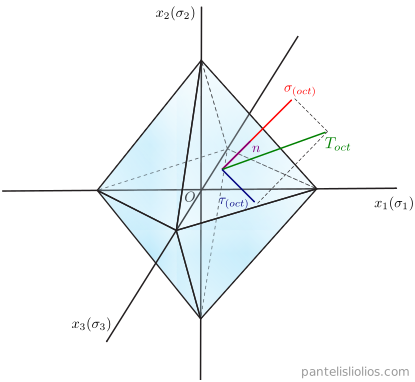
The normal and shear stresses acting on certain planes of a stressed body, the octahedral planes, are called octahedral stresses. If we take the principal directions as the coordinate axes (see also the article: Principal stresses and stress invariants), then a plane whose normal vector makes equal angles with the coordinate axes is called an octahedral plane. There are eight such planes, which form a regular octahedron, as illustrated in Fig. 1.
Figure 1: The eight octahedral planes, whose normals make equal angles with the principal axes, form a regular octahedron.
Since the normal of an octahedral plane makes equal angles with the coordinate axes and n12+n22+n32=1, its direction cosines are n1=n2=n3=±1/3. The 23=8 combinations of signs give the unit normals n=(±1,±1,±1)/3 of the eight faces of the octahedron. In this coordinate system the stress tensor at point O (the origin) is diagonal:
σij=σ1000σ2000σ3(1)
where σ1, σ2 and σ3 are the principal stresses. The components of the stress vector acting on an octahedral plane are given by Cauchy’s formula (for more details see: Calculation of normal and shear stress on a plane):
Ti(oct)=σijnj(2)
which, for the plane with n=(1,1,1)/3, gives simply Ti(oct)=(σ1,σ2,σ3)/3. Then, the octahedral normal stress σoct is:
where I1 is the first invariant of the stress tensor and p is the mean or hydrostatic stress (see the article: Deviatoric stress and invariants). Next, the magnitude of the stress vector squared is:
Ti(oct)Ti(oct)=31(σ12+σ22+σ32)(4)
and the octahedral shear stress τoct follows from the Pythagorean theorem:
where I2 is the second invariant of the stress tensor and J2 is the second invariant of the deviatoric stress tensor. In an arbitrary (non-principal) coordinate system, the square of the octahedral shear stress can be written in terms of the stress components as:
Since σoct and τoct depend only on the stress invariants, they are the same on all eight octahedral planes and can be calculated without determining the principal stresses. Moreover, they reflect the decomposition of the stress tensor into its hydrostatic and deviatoric parts: σoct is equal to the mean stress p, while τoct depends only on the deviatoric stress tensor, through J2.
Example
Calculate the octahedral stresses for the following stress tensor:
σij=4−2−1−234−14−2(7)
Solution
The given tensor is not expressed in the principal coordinate system. However, according to Eqs. (3) and (5), the octahedral stresses depend only on the invariants, so we only have to calculate the first and second invariants of the stress tensor. Using the expressions from the article Principal stresses and stress invariants we get:
As a check, the second deviatoric invariant is J2=31I12−I2=325+23=394, so 32J2=3188. The same result follows directly from the stress components with Eq. (6):